



Python implementation of the CBAS algorithm (Choice-Wide Behavioral Association Study) for identifying behavioral sequences that differ significantly between experimental groups or correlate with a continuous measure.
Uses Romano-Wolf step-down for multiple comparison correction and k-FWER iteration for false discovery proportion control.
Reference: Kastner et al., "Choice-Wide Behavioral Association Study" (2026 preprint)
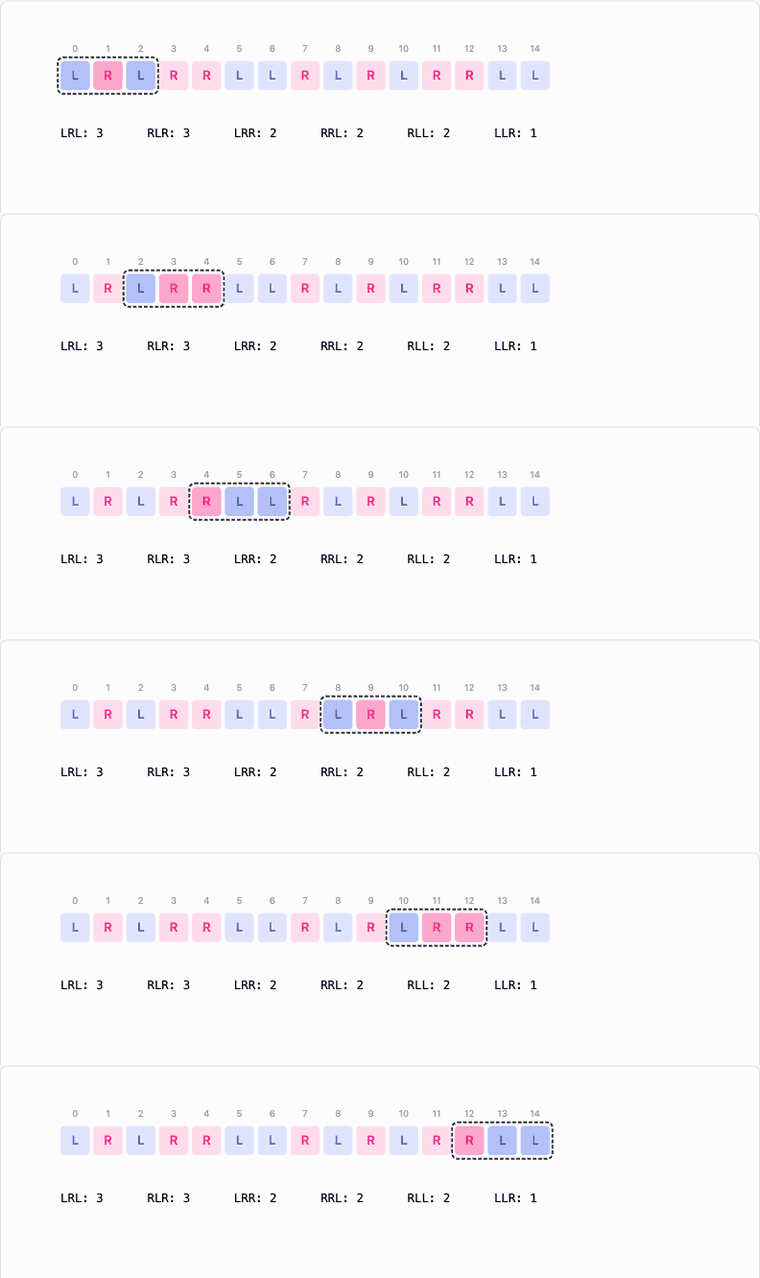
A sliding window walks each subject's choice stream and counts every subsequence up to length seq_len_max. Each unique sequence becomes one column of a subject-by-sequence count matrix, and one hypothesis test.
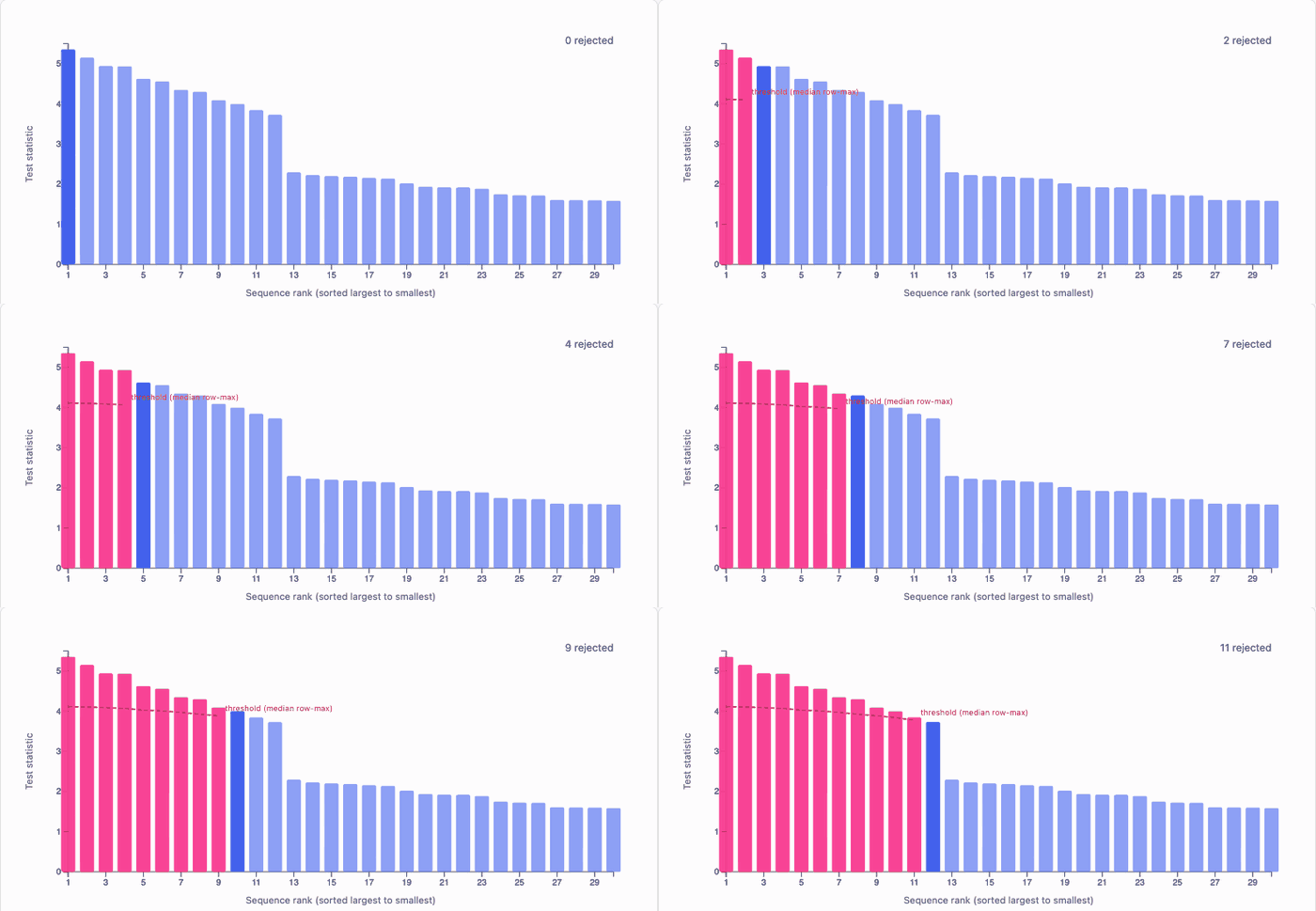
Testing thousands of sequences needs multiple-comparison correction, but Bonferroni's single fixed threshold is far too strict here. Romano-Wolf step-down instead recomputes the threshold from the bootstrap null after every rejection, over only the sequences that remain. The bar drops as strong effects are peeled off, so moderate effects can still clear it:
k-FWER iteration then relaxes "no false positives" to "at most k", raising k until the false discovery proportion is bounded by gamma.
Both animations are interactive in the walkthrough, which builds up the whole algorithm step by step.
pip install pycbasFor the interactive GUI:
pip install 'pycbas[gui]'
pycbas gui
Load data, confirm the auto-detected mode, set parameters, run, and explore results — no code required.
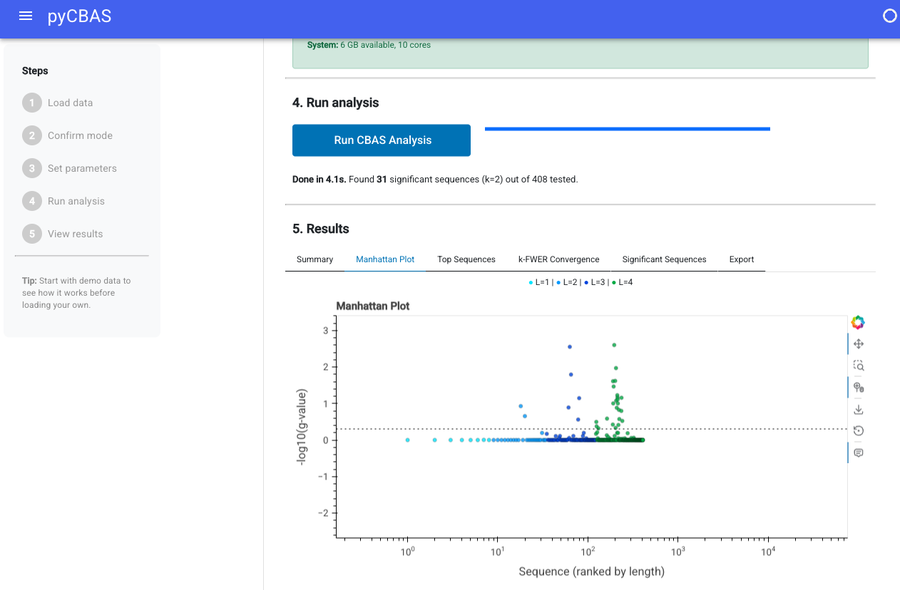
See the GUI documentation for details.
We recommend installing in a dedicated environment (conda, mamba, or pixi) rather than your base environment.
git clone https://github.com/droumis/pycbas.git
cd pycbas

# option 1: pixi (handles everything)
pixi install

# option 2: conda/mamba + pip
conda create -n pycbas python=3.11
conda activate pycbas
pip install -e '.[dev]'from pycbas import CBASParams, load_subject_data, run_cbas_comparative
subjects_data = [load_subject_data(f) for f in data_files]
group_labels = [0, 0, 0, 1, 1, 1]
params = CBASParams(
num_arms=6,
seq_len_max=6,
criterion=800,
resample_number=10000,
)
result = run_cbas_comparative(subjects_data, group_labels, params)
print(f"{result.n_significant} significant sequences (k={result.k_final})")from pycbas import run_cbas_correlative
result = run_cbas_correlative(subjects_data, cbit_scores, params)from pycbas import estimate_resources, print_resource_estimate
est = estimate_resources(num_arms=12, seq_len_max=8, n_observed=5000)
print_resource_estimate(est)| Parameter | Default | Description |
|---|---|---|
num_arms |
6 | Number of base symbols (choices) |
seq_len_max |
6 | Maximum sequence length L |
criterion |
800 | Number of trials used per subject |
resample_number |
10,000 | Bootstrap resamples M |
alpha |
0.5 | Significance threshold for FDP control |
gamma |
0.05 | FDP tolerance |
centering |
False | Center bootstrap null (False matches Igor) |
block_aware |
False | Prevent sequences from spanning block/session boundaries |
| Dataset | Subjects | Sequences | Time | Peak RAM |
|---|---|---|---|---|
| Flies (2-arm, L=10) | 1,566 | 2,046 | ~21s | ~560 MB |
| Humans (6-arm, L=4) | 1,413 | 408 | ~3s | ~155 MB |
| Rats (6-arm, L=6) | 105 | 16,378 | ~11s | ~3.6 GB |
Timings on Apple M-series. The chunked pipeline (chunked=True, default) trades ~30% more time for ~40% less memory. Bootstrap and step-down are parallelized via numba. Set NUMBA_DISABLE_JIT=1 to disable for debugging.
Exact match with the original Igor implementation on flies (1,605/2,046, k=81) and humans (31/408, k=2). Test statistics match to floating-point precision. Rats (105 subjects, block_aware=True): 572/16,378 significant (k=29), exact match with David's Igor implementation. Test statistics agree within 1e-6 on all 16,376 overlapping sequences.
See results/validation_summary.md for details, or per-dataset reports:
Full docs at droumis.github.io/pycbas
- User Guide - data format, parameter selection, working with results
- Algorithm - the step-down and k-FWER procedure in detail
- API Reference - all public functions and classes
pixi install          # set up environment
pixi run test         # run tests
pixi run flies        # run fly analysis (paper params)
pixi run human        # run human analysis
pixi run rats # run rat analysisMIT