
A declarative DSL & compiler for reproducible gene-editing design.





Quickstart · Highlights · The language · Architecture · MCP server · Deep dive
Most agentic gene-editing tools are chat interfaces that produce a one-off answer. Helix treats an editing experiment as source code: you write a small declarative spec (the intent), and a deterministic compiler — assisted by narrowly-scoped LLM agents — turns it into a fully resolved, provenance-stamped design you can diff, version, review, and re-run.
The key rule: agents may only emit or edit a spec; only the deterministic compiler produces the design. That keeps the trust boundary auditable and every run reproducible — the same audit trail that protects a human protects an agent.
- 🧬 8 modalities — knockout · base editing (CBE/ABE/CGBE) · prime editing · HDR knock-in · dual-cut deletion · CRISPRi / CRISPRa.
- 🎯 Constraints are first-class — the compiler solves against them and reports infeasibility, instead of silently returning "the top N".
- 🔬 Protein-consequence aware — every coding edit is called silent · missense · premature-STOP (iSTOP) · stop-loss · frameshift, with guaranteed-synonymous HDR PAM-blocks.
- 🧪 Variant-aware guides — flags common population SNPs in the seed/PAM (a SNP there abolishes binding in carriers).
- 🔌 Injectable backends — swap a heuristic for a real tool (Cas-OFFinder, inDelphi, BE-Hive, PRIDICT, Ensembl/NCBI, ESMFold) by editing the spec, not the code.
- 🤖 MCP server + LLM agents — any agent can drive the compiler through the spec → compile boundary.
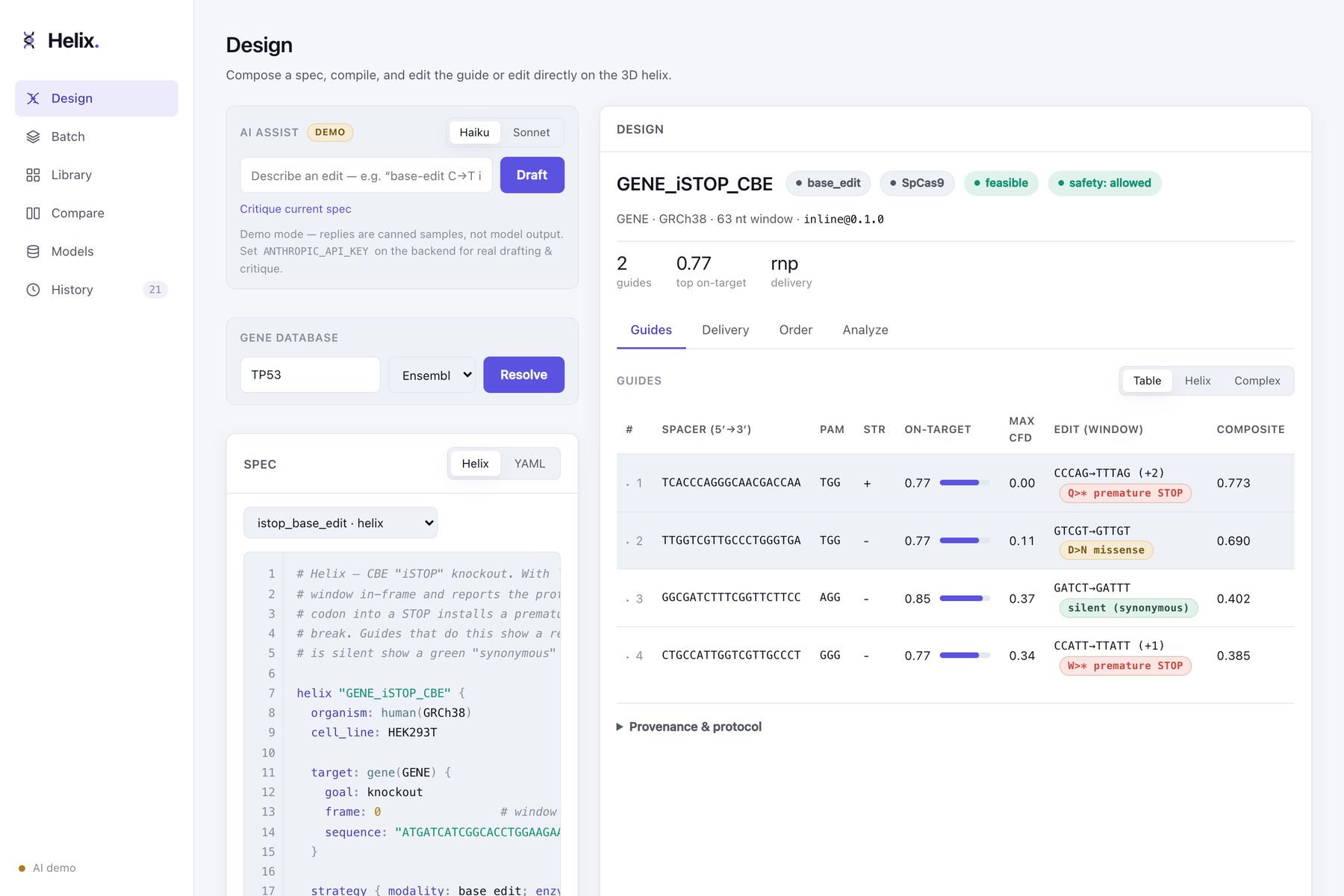
- 🖥️ Web UI — syntax-highlighting editor, interactive 3D helix, order-ready oligos, and results analysis.
- ♻️ Reproducible & auditable — every design is provenance-stamped; diff and version it in git.
pip install helix-dsl                                       # or: pip install -e '.[all]'

helix compile examples/tp53_ko.hx -o out                    # knockout (SpCas9)
helix compile examples/istop_base_edit.hx                   # base editing → iSTOP knockout
helix compile examples/tp53_prime_edit.hx                   # prime editing (pegRNA)
helix compile examples/tp53_knock_in.hx                     # HDR knock-in (cut + donor)
helix compile examples/tp53_ko_ensembl.hx                   # resolves TP53 from Ensembl (network)
helix validate examples/tp53_ko.hx                          # parse + safety screen only
compile prints a Markdown protocol and (with -o) writes out/design.json (the
reproducible record) and out/protocol.md (what a bench scientist reads). See all
eight modalities in examples/.
A Helix spec can be written in the Helix grammar (.hx) or YAML — both compile
to the same validated ExperimentSpec.
helix "TP53_KO_HEK293" {
  organism: human(GRCh38)
  profile:  strict                                 # preset efficiency / off-target / GC / hairpin defaults
  target: gene(TP53) { goal: knockout; region: exon(2..4); frame: 0 }
  strategy { modality: crispr_ko; enzyme: auto }   # `auto` → the compiler picks (delivery-aware)
  constraints {
    on_target.min_efficiency: 0.5
    off_target.max_cfd: 0.2
    gc.min: 0.4                                     # spacer GC window
    guides.count: 3
    avoid: [ homopolymer(>=4), self_complementary(>=8), common_variant(>=0.01) ]
  }
  simulate { sequence_provider: ensembl; on_target: rule_set_1; variant_source: ensembl }
  deliver: rnp
  validate: amplicon_seq
}- Guide-quality constraints — GC window, hairpin/self-complementarity, homopolymer, and restriction-site filters, each reported as a pass/fail check in the drill-down.
profile: strict | lenient | screen | quickpresets sensible defaults; anything you write overrides them. frame: 0unlocks the protein-consequence calls above and the guaranteed-synonymous HDR PAM-block.variant_source: ensembl+avoid: [common_variant(>=0.01)]reject guides with a common SNP in the seed/PAM.
Full grammar → GRAMMAR.md.
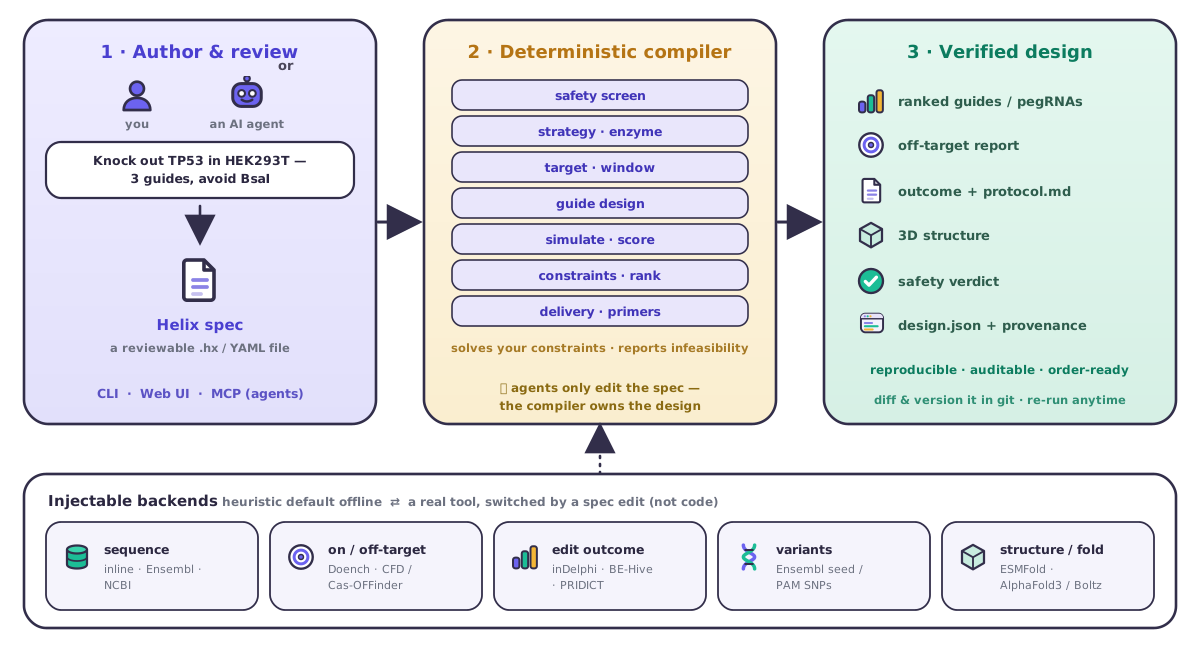
Three layers:
- Helix Studio — author and review a spec via the CLI, Web UI, or MCP (agents). The spec is the reviewable artifact.
- Deterministic compiler — a fixed pipeline (safety → strategy → target → guides → simulate → constraints → primers) plus narrowly-scoped LLM agents/builders and a provenance-stamped design store. Agents only touch the spec; the compiler owns the design.
- Simulate & score — pluggable backends score each candidate. Heuristics run offline by default; a spec edit swaps in a real tool.
Everything routes through injectable adapter Protocols, so the whole spine is testable offline and a real tool drops in behind the same interface. Deep dive → ARCHITECTURE.md.
Agents are good at writing a constrained spec and bad at safely orchestrating raw bioinformatics tools — exactly the split Helix is built around. So Helix ships as an MCP server: any MCP-capable agent (Claude, etc.) drives the compiler, but only through the spec → compile boundary.
helix mcp # stdio JSON-RPC server, zero extra deps (== python3 -m helix.mcp)Tools: helix_reference (grammar + guide + examples), helix_compile (spec →
ranked, safety-screened design summary), helix_resolve_gene (symbol → sequence +
locus), helix_list_models (selectable backends). MCP is simply a fourth transport
(alongside HTTP / subprocess / import) that connects agents to the compiler.
The deterministic spine runs fully offline on honest, clearly-labelled heuristics; each is a drop-in target for a real tool behind the same Protocol — selected by a spec edit.
| role | built-in | real tool (same interface) | status |
|---|---|---|---|
| sequence | inline |
ensembl, ncbi, fallback (Ensembl→NCBI) |
✅ live + fallback |
| on-target | heuristic_gc |
rule_set_1 (Doench 2014) |
✅ wired |
| off-target | mock_seed |
cas_offinder_cfd (CFD; scan needs a genome) |
✅ wired |
| repair outcome | mock_indel |
indelphi (Shen 2018) |
✅ wired |
| base-edit outcome | window_heuristic |
behive (Arbab 2020) |
✅ wired |
| prime-edit outcome | pe_heuristic |
pridict (Mathis 2023) |
✅ wired |
| structure / folding | esmfold (real, no key) |
AlphaFold3 / Boltz (HELIX_FOLDING_BIN) |
✅ ESMFold live |
The verified-real cores (Doench 2014, Doench 2016 CFD) are pure and always on; heavy
models sit behind injectable boundaries — configured in when a genome/tool is present,
and raising a clear error otherwise so the mock_* path always runs offline.
An interactive frontend (React + TypeScript, Vite) over a FastAPI backend — compile a spec and inspect ranked guides/pegRNAs, outcome metrics, feasibility, safety, provenance, and a delivery recommendation, in three views (Table · 3D helix · Cas9 complex). The helix is interactive: click a base to place an edit, drag to sweep it, and the compiler recompiles (a 3D → spec round-trip). Batch and Library modes, a design compare, a design-aware Models page, and a server-persisted run history round it out.
# One-command product: build the UI once, then serve UI + API on one origin.
cd frontend && npm install && npm run build && cd ..
pip install -e '.[web]' && helix serve       # full app on http://localhost:8000
Advanced — LLM agents · analysis loop · delivery · order export
- LLM agents (opt-in,
ANTHROPIC_API_KEY) —helix authorturns English into a.hxspec (validated by the real parser, self-repairing on error);--strategy llm|ragresolvesenzyme: auto(RAG cites a literature corpus);helix critiqueflags weaknesses and proposes IR-validated constraint edits;helix refineruns critique → recompile autonomously until convergence. The LLM sits behind an injectable client, fully tested offline with a fake. - Design → validate → analyse loop —
helix analyzeruns CRISPResso2 on amplicon reads and reconciles observed editing against the design's prediction. In the UI, an Analyze card does the same with a pure-Python caller (no install needed). - Order-ready oligos — every design exports guide cloning oligos (Golden Gate), pegRNA extensions, ssODN donors, and validation primers as a table + IDT CSV with a rough cost.
- Delivery-aware strategy — recommends RNP / plasmid / LNP / AAV from cargo size and context, honouring the single-AAV limit (an AAV knockout with
enzyme: autopicks the compact SaCas9). - Gene database — resolve a symbol to its edit window live from Ensembl / NCBI; the Models page lists every backend with a live ready / needs-setup status.